leave behind artifacts
Why documenting your non-linear journey matters.
A view core to my general life philosophy is that as humans we are highly irrational creatures and we fall victim to a significant number of psychological biases that cloud our judgment. These range from social mimicry to confirmation bias, to the anchoring effect and everything in between and beyond.
This becomes incredibly clear when we evaluate the past; whether our experience is viewed through rose-tinted glasses that make us perceive memories as overly nostalgic, or we pick apart our past performances in a hypercritical way, despite knowing that hindsight is 20/20.
The issue is that our perception of time tends to be anchored. If you think of yourself from 10 years ago, it's probably a very static picture. You think of a specific grade, a specific phase, maybe a single defining memory. And that's generally how we view the past: in discrete time periods defined by a start and an end. That bias alone is incredibly harmful because it neglects the journey in the middle. You lose a ton of nuance.
The deeper idea though is that we're extremely inaccurate at remembering and reflecting on paths that are highly non-linear in nature. I believe that as humans we are incentivized to compress experience into recognizable patterns, much like we do explicitly with dimensionality reduction methods in ML. When we have a non-linear path, our mind compresses it into something more linear, something lower-dimensional (as a note here, I would also say that even if this is a higher-dimensional representation, it's very often still significantly compressed. Just as how the use of a low-dimensional quadratic function can't represent a series of data points, sometimes you need a quadratic function with a lot more dimensions). And in that compression, you lose richness.
So if 10 years ago you were sad, then a little happier, then a lot sadder, then happier, and now you're at the happiest you've ever been (which is in itself already a compression) ... you lose all of that texture. You only look at the starting point and the endpoint and draw a clean line between them.
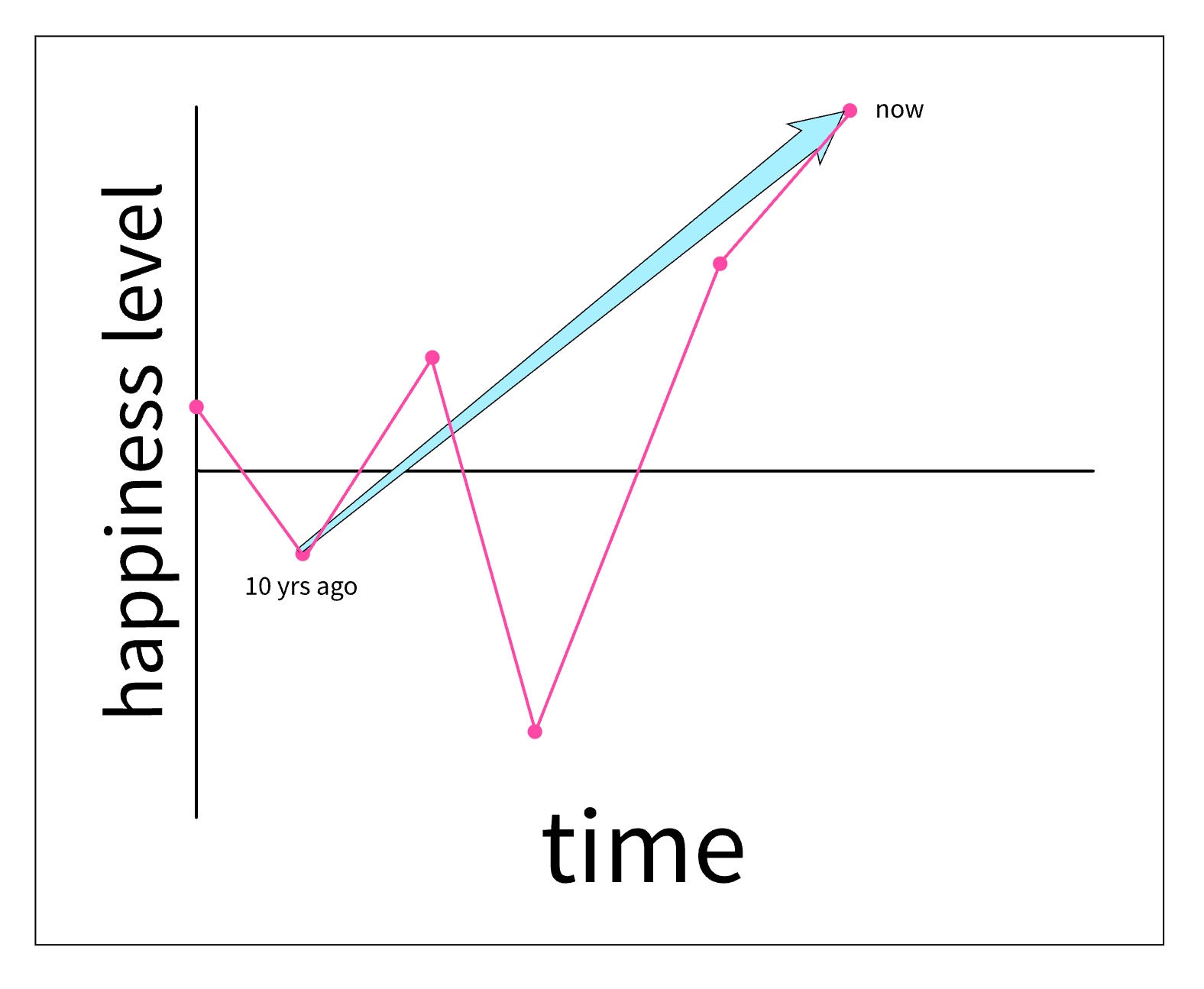
This matters to me right now because it's been weighing on my mind as I reflect on the non-linearity of entrepreneurship. There's a fundamental lack of measurability. Just as we gravitate toward wealth as a metric because it's the one number we can quantify within our careers, entrepreneurship at the "tinkering philosopher" stage is highly unquantified. And when there's no clear lasting metric on months-long timelines, the non-linear path you've actually taken gets compressed into an interpretation with massive loss.
Artifacts, whether journals, voice memos, or abstract art projects, are a way to capture that richness more accurately — a way to preserve more of the ups and downs rather than smoothing everything into a single line.
This becomes even more important as compression doesn't distort in isolation. It compounds with every other bias we carry. If I already believe I'm smart and productive, confirmation bias means I'll look back and find evidence for that. If I'm anchoring to what I think others could achieve in the same timeframe, or what I "should" have achieved, my evaluation gets pulled toward that reference point. Taken together, leaving behind artifacts lets you interact with the past in a much richer way, one that pushes back against all of these distortions at once rather than just addressing them one by one.
The simplest metaphor to capture this is that it's like checking alignment on your car. If you let go of the wheel and see yourself drifting into the left or right lane, you're able to correct only because the lane lines exist. I think we need those lines. We need that objective representation. And that objective representation is exactly what you should invest in building, in whatever artifact form makes sense for you.